Responses to objections raised by some PA legislators:
On January 7, Fair Districts PA Chair Carol Kuniholm spoke on Zoom about the work of redistricting reform in Pennsylvania. In one section of her presentation, she addressed some common objections raised by Pennsylvania legislators. Those objections are described and addressed, with some links, below.
Some PA legislators say “The current process for PA House and Senate is accountable to voters. A commission would not be.”
THE FACTS: The current process for PA House and Senate is NOT accountable or responsive to voters. A commission would be far more responsive.
At present, PA House and Senate maps are drawn by a five-person commission: minority and majority leaders from both chambers, and a chair chosen by those four leaders, or, if they fail to agree (as has consistently been the case), a chair chosen by a majority of the PA Supreme Court.
Legislators do not get a vote on final House and Senate maps, the governor has no role, and commissioners are not required to explain why they drew lines where they did.
Pennsylvania’s current state legislative redistricting process allows party leaders more direct control over their own and their colleagues’ districts than any other in the country, and is one of the least accountable.
The current process also enables leadership control over other aspects of the PA legislative process in a way that undermines rank-and-file legislators’ ability to represent their constituents. Learn more about that here.
Some PA legislators say “HB 31 and SB 131 would require proportionality. That’s bad for PA.”
THE FACTS: Fair Districts PA does not advocate for proportionality, and a quick search of either House Bill 31 or Senate Bill 131 will show that the words “proportional” and “proportionality” don’t appear. Instead, the bills state, in § 19. Redistricting criteria:
“(3) A redistricting plan may not provide an advantage to any political party. An advantage to a political party shall be determined by using accepted measures of partisan fairness.”
Proportionality is unworkable for a number of reasons.
Geographic distribution of voters can make proportionality impossible. In Pennsylvania, members of the two major parties are unevenly disbursed. The deepest-red districts in PA are about 80% Republican. The deepest-blue districts (in the heart of Philadelphia) are over 90% Democratic. A proportionality requirement would work in direct opposition to compactness, and prohibitions against splitting of counties and municipalities. In the long run, diminish representation for Republican and Democratic communities alike.
Another concern about proportionality: it takes for granted a two-party system and ignores the reality of third-party and independent voters. Proportionality would require third-party candidates receive seats equal to the statewide vote share, even if those votes were never concentrated enough in one district to provide a majority. That’s not a workable option.
The free mapping platform Dave’s Redistricting App (DRA) currently uses proportionality as the most visible measure of partisan fairness, despite the problems mentioned earlier. It’s easiest to measure and easiest to explain. DRA also provides many more metrics in the advanced section (briefly explained here). While measures of partisan fairness continue to evolve, there is growing consensus about respected measures. Nonpartisan PlanScore provides those scores along with some explanation
Some PA legislators say “Fair Districts PA drew the current PA House map.”
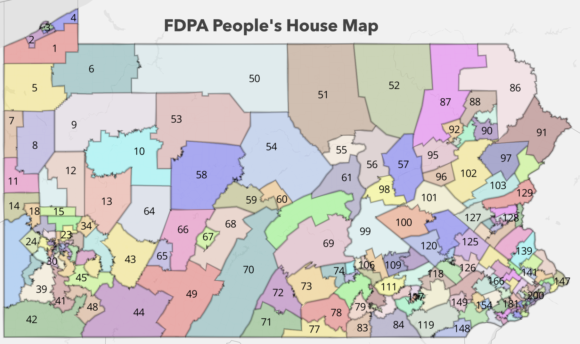
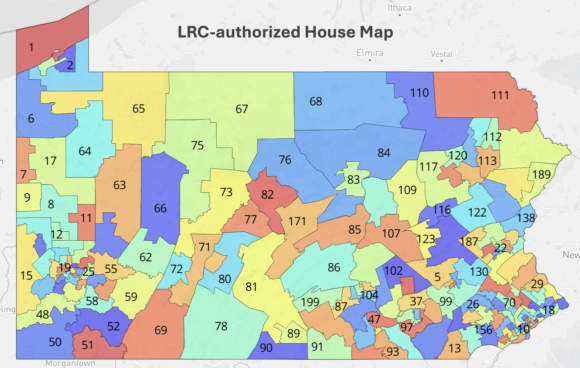
THE FACTS: Fair Districts PA submitted People’s House and Senate maps, based on input from hundreds of supporters and from mapping conversations from across PA. We have no evidence those maps had any significant influence on the final maps.
A quick comparison of the proposed People’s House and current House map should make clear there are few, if any, similarities.
Find a longer discussion of this in our July 29, 2025 web update: Who Drew the Maps?
Here’s the FDPA People’s House Map submitted to the LRC.
And here’s the LRC-authorized House map that’s currently in effect.
Some PA legislators say: “An independent commission will result in worse gerrymandering as it will be accountable to the moneyed interests to get commission members in place.”
THE FACTS: As the most populous swing state in the country, with few restrictions and safeguards regarding the influence of moneyed interests, PA is already a top target for both outside spending and partisan gerrymandering. The proposed selection process and other safeguards would make it much more difficult, and much less legal, for moneyed interests to control the outcomes, either in selection or in the mapping process itself.
A reference noted elsewhere in the presentation points to the intersection of gerrymandering and money in politics: ‘Money and politics, and partisan gerrymandering, matter more than any other electoral rules today’, Harvard Law Today, February 07, 2025.
Some PA legislators say: “Given what is happening nationally, this isn’t the time for an independent redistricting commission. You can’t bring a knife fight to a gun fight. You have to fight fire with fire.”
THE FACTS: From a practical perspective, no one knows who will control the PA House or Senate; no one knows who will sit in the Governor’s office or hold the PA Supreme Court majority. So no one knows who will have the final say in determining Pennsylvania voting districts. Wouldn’t it make sense to put safeguards in place so PA isn’t a top target in an escalating redistricting battle?
From a more values-based perspective: You can’t save democracy by destroying democracy.
No one can say how the national redistricting drama will impact seats in Congress, but as an op-ed in Governing makes clear, voters, all voters, are the real losers in the redistricting war.
Fundamental to a representative democracy is a simple principle: the people choose their representatives. It’s not that representatives choose their constituents. The founders envisioned the House of Representatives as the people’s house, representing and accountable to the voters.
In the current mid-decade redistricting, the legislators are handpicking their constituencies.
American Democracy
In September 2025 the American Bar Association released The Task Force On American Democracy Final Report, the outcome of a two year study on challenges facing democracy in the United States.
According to the report:
“Overall, politicized redistricting is an important driving force in the crisis of democracy in the United States; it is at the core of political dysfunction and polarization today. Americans are losing confidence that their elected representatives speak for them. Those representatives are less and less incentivized to govern effectively, thereby feeding the perception that democratic governance is ineffective.”
As a proposed solution:
“The Task Force endorses the ABA’s own prior recommendations for redistricting reform. In 2008, the ABA House of Delegates formally adopted a resolution calling for all jurisdictions in the United States to institute independent commissions with authority to conduct congressional and state legislative redistricting”.